Private AI · on your hardware · behind your firewall
Private AI your whole organization can actually log into.
Enclave turns NVIDIA-accelerated hardware into a complete AI application: single sign-on, permission-aware retrieval, answers cited to their source documents, and a full audit trail. Deployed on your systems, in your building. Your documents never leave your network.
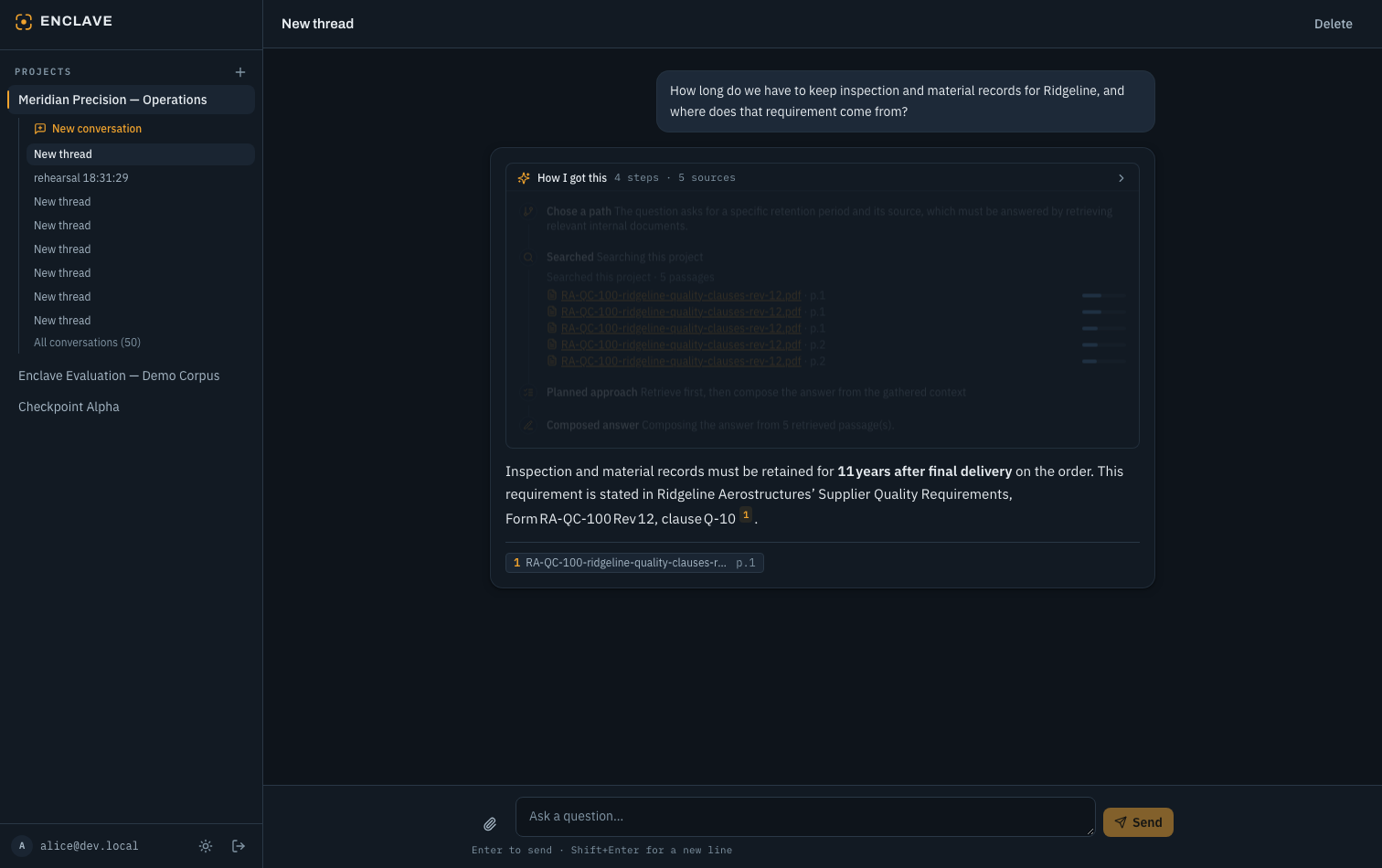
The Enclave application — a cited answer with its execution trail. Demo environment, fictional aerospace-supplier corpus.
Why Enclave
The cluster is the easy part.
Racked GPUs, validated drivers, the NVIDIA software stack installed and burned in — a good hardware partner handles that well. Then comes the question that stalls most private-AI projects: how do 400 employees actually use this — and how do you stop the wrong ones from reading HR files? Enclave is the answer to that question: the production application layer that ships on the box.
An application, not a toolkit
Your people get a chat application they sign into with the company credentials they already have — not a framework your team has to finish building.
Permissions, provable
Retrieval is scoped to what each person is allowed to read, enforced at the API — and the audit trail proves it, question by question.
Accountable answers
Document-grounded answers cite their sources and show the steps taken. The deployment is accepted against a scored evaluation — not a demo.
The platform
What "working private AI" actually includes
Not a chatbot bolted to a folder. A governed answer engine your security team can sign off on — running as four hardened services on the delivered hardware.
Answers with citations — document-grounded responses link to their supporting sources, so users can verify.
Visible steps — an expandable trail of routing decisions, searches, sources, and tool use behind the answer.
Projects — persistent workspaces that keep a team's documents, conversations, and context together.
Beyond the paragraphs — extract text, tables, charts, and diagrams from supported PDFs and slide decks, with processing tuned to your document mix.
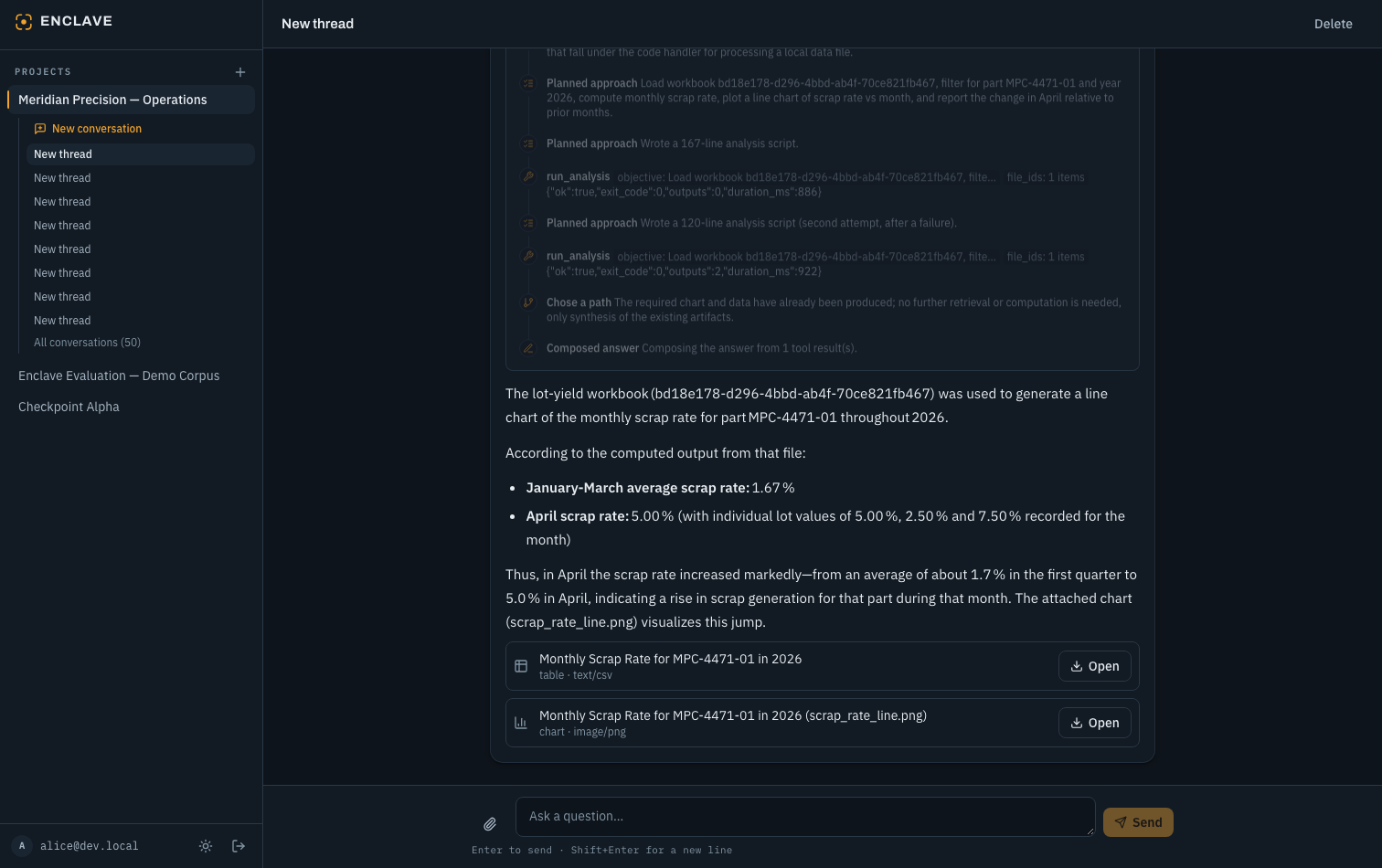
Analysis on request — computations and charts generated from your data files, in a locked-down sandbox, on the box.
For the security & compliance team
Governance that survives an audit
Single sign-on — your identity provider (Microsoft Entra ID and other OIDC providers), with role- and group-based access control.
Permission-aware retrieval — access rules are enforced before search, using directory-group grants and configured SharePoint document-permission sync.
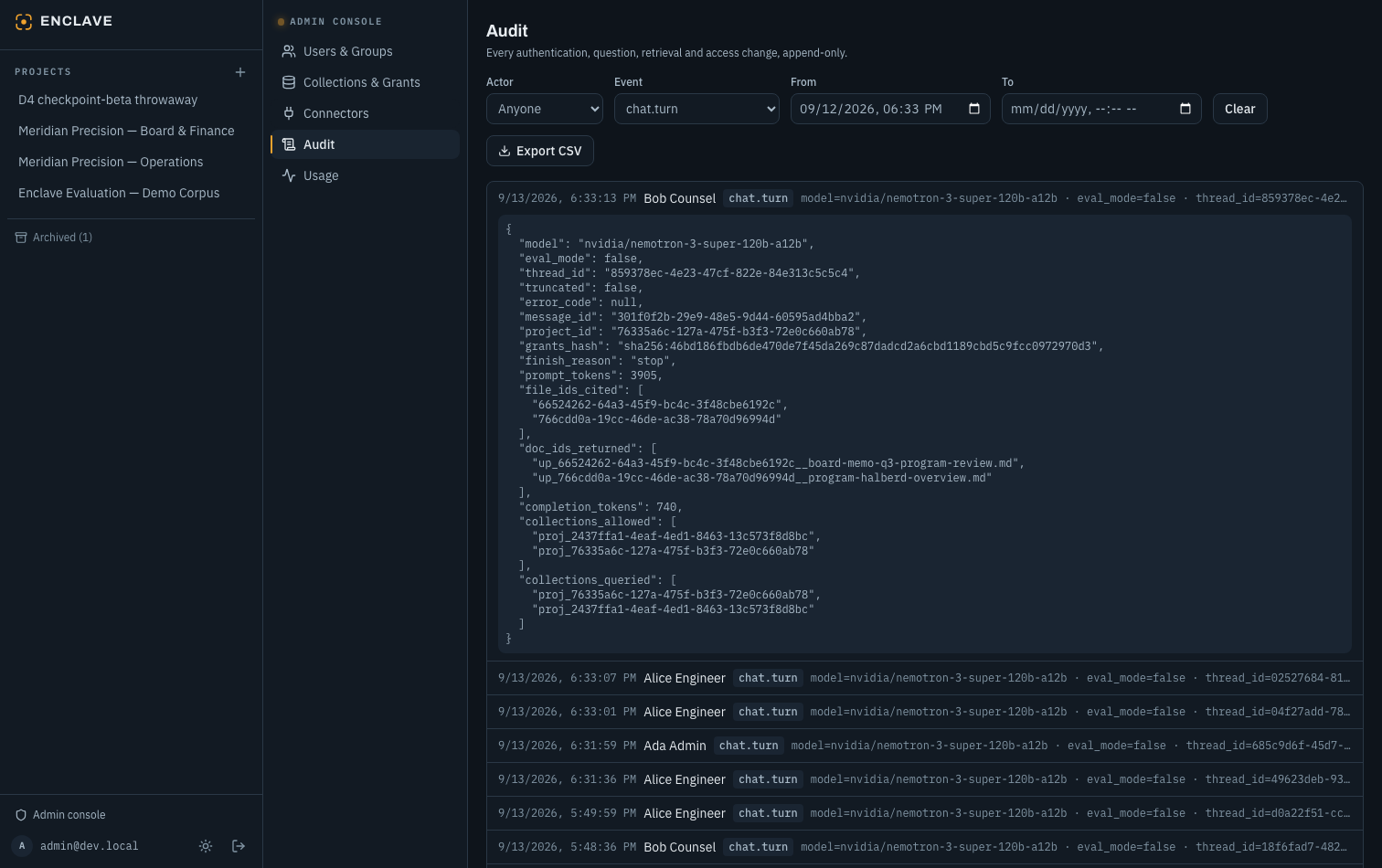
Append-only audit trail — who asked, what was retrieved, which model answered, exportable to CSV.
Guardrails — topic control, content safety, and prompt-injection defense at the platform layer.
Service-to-service mTLS — available for Enclave’s internal service connections in the production profile.
For the team that owns it after go-live
Engineering that keeps answers good
Keep your corpus current — scheduled SharePoint sync, including deletions, plus scheduled ingestion from approved file-system locations.
Retrieval tuned to your corpus — hybrid search with reranking, chunking calibrated to your actual documents, not defaults.
Measured before sign-off — acceptance is a scored evaluation on a question set built with your team, with negative controls. Sign-off is a number, not a vibe.
Sized to the workload — model selection and GPU allocation engineered for the stated user count.
Operable — ingestion status and retries, metrics, tracing, token-usage accounting, backup and restore runbooks, and a managed-operations tier.
enclave — analysis agent
The analysis agent: sandboxed computation over your files, with the chart and the working shown.
What happens between your question and the answer: every turn is routed by a supervisor — to document retrieval, to a locked-down analysis sandbox, or to a connected system — and composed only when enough has been gathered. A greeting never triggers a search; a data question never gets a guess. The same trail your people see in "How I got this" is this loop, step by step:
The application brain. The NVIDIA RAG Blueprint runs stock underneath as the retrieval engine — see the full architecture.
UNDER THE HOOD · NVIDIA RAG Blueprint · NVIDIA NIM™ microservices · NVIDIA NeMo™ Retriever extraction, embedding + reranking · LangGraph agent orchestration · Elasticsearch hybrid vector search · OpenID Connect SSO · Postgres audit & state · Prometheus + OpenTelemetry · Docker Compose delivery · production mTLS for Enclave service connections — see the full stack
Two front doors
The full workspace — and a copilot inside the apps you already run.
Every deployment includes two interfaces to the same governed platform. Roll out the workspace as your organization's AI home base, embed the copilot where work already happens — or do both from day one.
The workspace
A home base for deep work
The full application your teams sign into — everything pictured on this page:
Projects — persistent workspaces holding a team's documents, conversations, and context.
Cited answers — with the expandable execution trail behind document-grounded responses.
The analysis sandbox — computation and charts over your data files, on the box.
Admin, settings & audit consoles — users, connectors, interface branding, and the append-only audit trail.
The embedded copilot
Your existing apps, AI-enabled
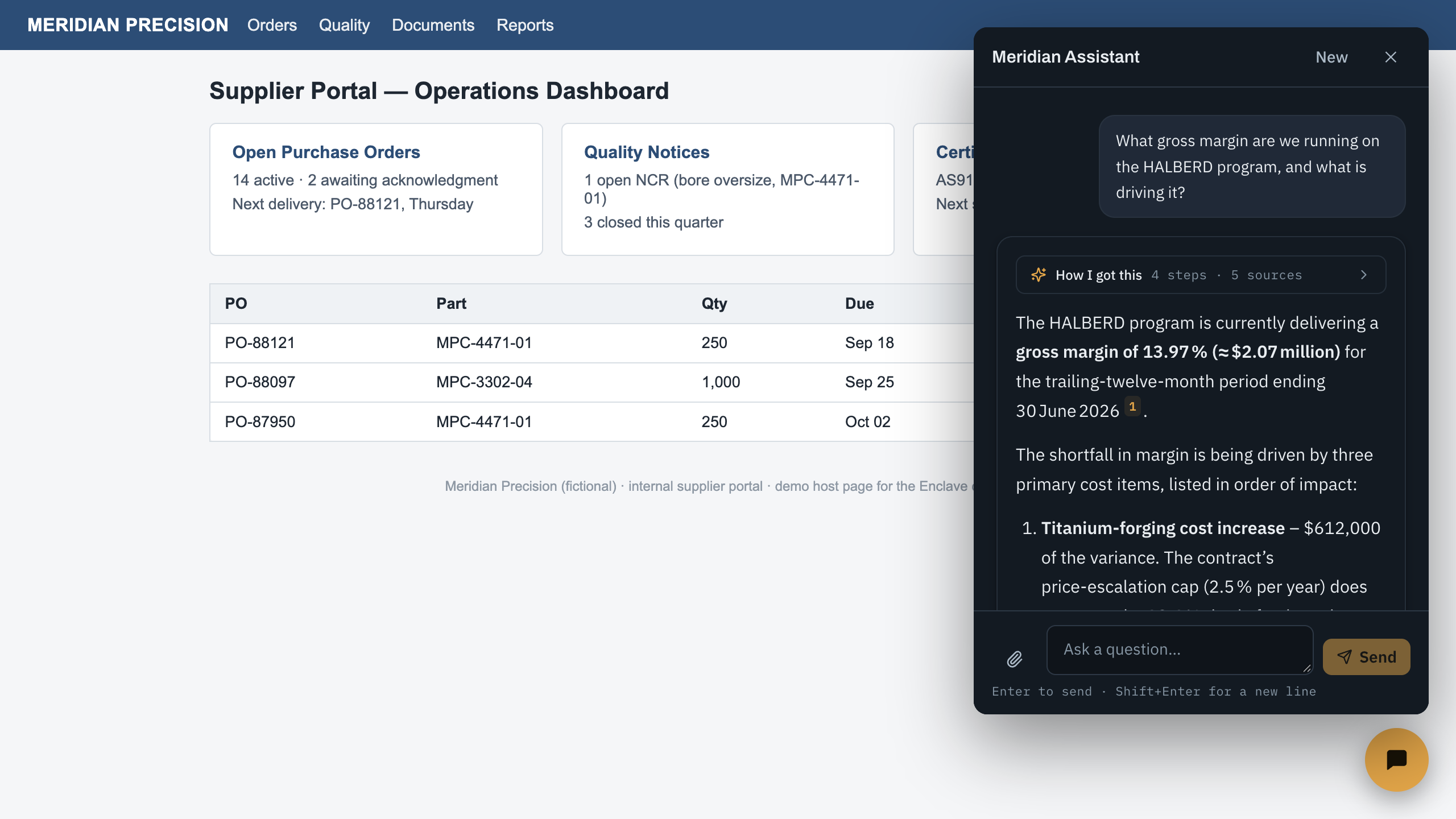
Add one script tag to a compatible internal web application — intranet, ERP portal, wiki, dispatch console — and a copilot panel appears inside it. Same sign-on, same permissions, same citations, same audit trail: the same platform, through a different door.
It uses isolated styling and an iframe-based panel — and only domains you allowlist may embed it. Appearance for both interfaces — launcher position, label, colors, panel title — is managed centrally from the admin settings page, so changes roll out without touching the host application.
Segmented by design. Different doors never mean different rules. Each copilot is bound to a workspace — HR's portal embeds a copilot grounded in HR's datasets, engineering's in theirs — and within any door, every user's retrieval is filtered to the datasets their directory groups grant, enforced on every request at the platform layer, not hidden in the UI. Two people can ask the same copilot the same question and get different answers, each drawn only from what that person is allowed to see. Administrators manage the whole map centrally — groups to datasets, datasets to workspaces — and the audit trail records exactly which access rules produced every answer.
supplier-portal.customer.internal
The copilot inside a customer's existing application — signed in through the customer's identity provider, answering only from what this user is allowed to read, every claim cited. The page is theirs; the panel is two lines of pasted code. Demo environment, fictional company.
Security & governance
Built for buyers whose data can't leave
Defense suppliers working in DFARS 252.204-7012 and NIST SP 800-171 CUI environments. State and local government. Community banks and credit unions. Law firms. If your policy says client data doesn't touch public AI services, Enclave is built for you: the entire pipeline — models, retrieval, storage, audit — runs on hardware you own.
enclave — admin console · audit
The audit trail: every question records who asked, what they were permitted to search, what was retrieved, and which model answered.
Access control
Users and groups flow in from your identity provider. Administrators grant collections to groups; the retrieval API enforces the grants on every query — the UI never has to be trusted.
Every turn on the record
The audit log captures the permission scope each answer was computed under — which collections the asker was allowed, which were queried, which documents were cited.
Deployment hardening
The AI engine is never exposed directly: one authenticated edge, production mTLS for Enclave service connections, sandboxed code execution with no network access, secrets outside the repo.
How you buy
Fixed scope. Fixed price. Measured acceptance.
It starts with a demo, not an invoice: fifteen minutes, live, on real documents. Then, when you want it on your hardware — no per-seat subscriptions, no metered tokens. You buy a deployment with a written scope and a scored acceptance evaluation, and an optional managed tier that keeps it good after go-live. Hardware is quoted separately by your integration partner; if you don't have one, we'll introduce you to one.
Package
What you get
Price
Assessment first step
Corpus survey, permission-model review, hardware sizing, written findings and a firm fixed quote
$2,500 · credited
Pilot working in 30 days from readiness
Single system (2× NVIDIA RTX™ PRO 6000-class), one document corpus, branded chat application, single sign-on, up to 25 users, guardrails, admin training, scored acceptance demo
$25,000 fixed
Production
Everything in Pilot, plus SharePoint sync with configured document permissions, plus file-system ingestion, ingestion tuning on your real corpus, an evaluation gold set built with your team, monitoring, backup/restore runbooks, admin console
$55–95k fixed-scope
Managed AI the ongoing tier
Patching and upgrade cadence, model refreshes, index maintenance, quarterly quality report scored against your gold set, next-business-day support
$3.5–4.5k / mo
NVIDIA edition
Built on the NVIDIA RAG Blueprint with NVIDIA NIM microservices and NVIDIA NeMo Retriever, under an NVIDIA AI Enterprise subscription (licensed per GPU, resold with the deployment). For compliance-driven buyers who need the commercially supported stack.
Acceptance is a scored evaluation on a question set built with your team — including questions the system should refuse — with written pass criteria. You sign off on a number, not a feeling.
HOW EVERY ENGAGEMENT ENDS
The foundation
Built on the NVIDIA AI stack
Enclave productionizes the NVIDIA RAG Blueprint — NVIDIA's reference architecture for enterprise retrieval-augmented generation — and adds the application layer it deliberately leaves to independent software vendors: identity, permissions, connectors, agents, audit, and evaluation. We build on the Blueprint and track its releases; we never fork it.
OpenAI's open-weight model. Running in your building.
The chat model on Enclave's reference configuration is gpt-oss-120b — OpenAI's open-weight reasoning model, released under the Apache 2.0 license and served entirely on your own GPUs. Your people get the model family they have been asking for, and your security team gets the answer they need: the weights live on the box, and nothing about a question, a document, or an answer leaves your network to use it.
Served locally
gpt-oss-120b is a 117-billion-parameter mixture-of-experts model that fits on a single 80 GB-class GPU. On the reference box it runs on one NVIDIA RTX PRO 6000 as an NVIDIA NIM microservice, under the same NVIDIA AI Enterprise support as the rest of the stack.
Open weights, no strings
Apache 2.0 is a permissive license with no copyleft and no per-seat model fee. You are not renting access to a model — the weights ship with the deployment and keep working with the network unplugged.
One API, supported chat models
Supported chat models connect through an OpenAI-compatible API, so model refreshes can be configured without rebuilding the application and validated against your acceptance set. The audit trail records which model answered each question, so a swap is visible, not silent.
Extranetic Inc., the company behind Enclave, is a member of the OpenAI Partner Network. Enclave is an independent product; OpenAI does not endorse or sponsor it.
Delivery
Delivered with your hardware partner
Enclave is software. We don't rack servers, design clusters, or sell hardware — your GPU integration partner does that, and does it well. We work alongside them: the platform is installed at integration time, so the system ships working, and your data onboarding happens after delivery, inside your network. Already have a hardware partner? We'll work with them. Need one? We'll introduce you.
Enclave's founder, Rian Sousa, architected the initial end-to-end design of a U.S. state treasury's private AI platform and worked with a team to develop it from scratch — multi-agent retrieval over sensitive financial data, local models, enterprise SSO and role-based access, zero-trust architecture, Kubernetes. The architecture evolved as the team grew and the scope expanded. Enclave is an independent, AI-native product built from the ground up on the NVIDIA RAG Blueprint — experience applied, nothing carried over.
Local inference on NVIDIA hardware. Cited answers and the embedded copilot have been demonstrated on the reference GPUs. Lab ingestion has been tested with internet egress blocked.
Ten years of white-label channel delivery — a partner program operated entirely under the partners' brands, across 33 states.
Engineering you can inspect — 3,500+ automated tests, a scored evaluation harness with negative controls, and screenshots on this page taken from the running product, not mockups.
OpenAI Partner Network member. Enclave runs OpenAI's open-weight gpt-oss-120b locally on your own hardware — the model family your people are asking for, with nothing leaving your network to use it. How the model is served →
Next step
Start with a demo.
Fifteen minutes, live: sign-in, a cited answer with its execution trail, two users getting provably different answers from the same question, and the audit log that recorded all of it. When you've seen it, the $2,500 Assessment (credited toward your build) turns your corpus and permission model into a firm fixed quote.